
Reviewed · CITY TOURS
Gondar city Tour With Airport & Hotel Pick Up
Gondar rewards the curious. This half-day city tour brings together Fasil Ghebbi’s royal castles and the painted Debre Birhan Selassie Church, two of Ethiopia’s most memorable sights. I like the included entrance fees and air-conditioned vehicle, and I also like that airport pickup can save you time after arrival. The main consideration is the pace: seven and a half hours, with four substantial stops, can feel full on a warm day.
I also appreciate the small group limit of 10 and the tour’s useful mix of imperial history, religious art, and local culture. A past booking was carefully organized by Mickey, who arranged airport reception and connected the visitor with strong local guides. Still, confirm the exact pickup point in advance, since the published meeting point is Central Hotel while airport pickup is also offered.
In This Review
- Key points to know before booking
- Why Gondar works so well as a one-day city tour
- Entering Fasil Ghebbi, Gondar’s royal enclosure
- Fasilides Bath and the annual Timkat ceremony
- Debre Birhan Selassie and Gondar’s painted church art
- Wolleka and the story of Gondar’s Ethiopian Jewish community
- The guide and vehicle make the schedule easier
- Is $90 a fair price for Gondar?
- Timing, cancellation, and who should book
- FAQ
- Where does the Gondar city tour start?
- What time does the tour begin?
- How long does the experience last?
- Does the tour offer airport pickup?
- Where does the tour end?
- What is included in the $90 price?
- How many people can join the tour?
- Is Fasil Ghebbi admission included?
- Can I cancel for a full refund?
Key points to know before booking
- Fasil Ghebbi takes the longest visit: Allow about two and a half hours for the royal enclosure, palaces, churches, and former ceremonial grounds.
- Debre Birhan Selassie is the artistic highlight: Its ceiling paintings and watchtowers make this church a major reason to visit Gondar.
- Fasilides Bath links history with Timkat: The compound is filled for Ethiopian Epiphany each January 19.
- Wolleka adds a difficult chapter: The former Ethiopian Jewish village offers cultural context, crafts, and a small synagogue, but persistent sellers can make the stop tiring.
- The tour is built for convenience: A vehicle, guide, entrance fees, taxes, and airport or hotel pickup support are included.
- A small group helps: With no more than 10 people, you have a better chance to hear the guide and ask questions.
Why Gondar works so well as a one-day city tour
Gondar was founded by Emperor Fasilides in the 1630s and served as the imperial capital of Ethiopia for roughly 250 years. That long royal role left behind an unusual concentration of castles, churches, ceremonial sites, and older neighborhoods.
I like Gondar because its story is easy to read in the buildings. At Fasil Ghebbi, you see royal power in stone. At Debre Birhan Selassie, you see faith expressed through paint. At Wolleka, you encounter a community that was once central to local life but has largely disappeared.
The tour begins at 9:00 a.m. and lasts about seven hours and 30 minutes. That gives you enough time to see the major sights without trying to squeeze Gondar into a rushed morning. The route also makes sense: start with the imperial center, continue to the bath, then visit the famous church and finish at Wolleka.
The $90 price needs to be judged as a package rather than as a simple sightseeing ticket. It includes an air-conditioned vehicle, guide service, entrance fees listed in the program, government taxes, and airport or departure tax. If you arrive by air and want someone to meet you, that convenience adds real value.
The maximum group size is 10. That is not a private tour, but it is small enough to avoid the feel of a large coach group. I would still confirm the pickup arrangement before the day begins. Central Hotel in Gondar is listed as the starting point and ending point, while pickup is also offered from the airport and hotels.
More city tours in Gondar:
- Addis Ababa Guided City Tour With Airport & Hotel Pick Up
★ 5.0 · 237 reviews - Full-Day Private City Tour of Addis Ababa
★ 5.0 · 147 reviews - Addis Ababa Authentic Private City Tour
★ 5.0 · 134 reviews
Entering Fasil Ghebbi, Gondar’s royal enclosure
Plan on about two and a half hours at Fasil Ghebbi. This is the tour’s longest stop, and rightly so. The fortified compound covers about 70,000 square meters and is enclosed by a wall roughly 900 meters long.
Fasil Ghebbi was the residence of Emperor Fasilides and later Ethiopian rulers during the 16th and 17th centuries. Inside, you find palaces, churches, monasteries, and public buildings. The architecture reflects several outside influences, including Hindu and Arab forms, along with Baroque ideas brought by Jesuit missionaries.
That mixture gives the site its character. You are not looking at one tidy architectural style. Instead, the buildings reflect Ethiopia’s position at a crossroads of religion, trade, diplomacy, and imperial ambition.
The enclosure also helps explain how Gondar functioned as a capital. Adababay, the marketplace just to the south, was once used for imperial proclamations, military presentations, and public executions. It is now a city park, but knowing its former role changes how you read the open space.
Dawit’s Hall is in the northern part of the enclosure, and the complex contains several structures tied to different rulers. You should expect the guide to do much of the interpreting here, since the scale and layered construction can otherwise feel confusing.
I like the generous time allowance at Fasil Ghebbi. Two and a half hours gives you room to look beyond the best-known palace and understand the compound as a working royal city. The drawback is that the ground may feel demanding if you prefer a quick, compact sightseeing stop. Good walking shoes are a sensible choice, though the supplied information does not specify the exact walking conditions.
The included admission fee is helpful here. Fasil Ghebbi is the kind of place where a guide adds value because names, dates, and buildings can blur together. Ask your guide to point out which structures belong to which period and how the royal compound changed over time.
Fasilides Bath and the annual Timkat ceremony
The next stop lasts about one hour and has no separate admission fee. Fasilides Bath is often linked to Emperor Fasilides or his son, Iyasu I, though the precise commissioner is not known.
The compound contains the bath, a central tower, and a bridge used when the pool is full. Ancient badian trees have grown into the old walls, with roots winding through the brickwork. That combination of water, masonry, and tree roots gives the place a different mood from the formal royal enclosure.
Fasilides Bath is especially important during Timkat, the Ethiopian Orthodox celebration of Epiphany. On January 19, the bath is filled as part of a ceremony that recalls the baptism of Christ in the Jordan River.
I find this stop valuable because it connects an old imperial structure with a living religious calendar. You are not just seeing a disused pool. You are seeing a place that still matters to Ethiopian Orthodox Christians.
The one-hour visit is enough for an overview, especially after the longer stop at Fasil Ghebbi. If you want extensive historical detail about the bath, the available tour information is less specific than it is for the royal enclosure and church. Your guide will be important in filling out the story.
The site also gives you a pause between larger attractions. After several palace buildings, a more contained compound can make the day feel better paced. I would not expect a long independent exploration here, but it is an essential part of Gondar’s royal story.
Debre Birhan Selassie and Gondar’s painted church art
Allow about two hours at Debre Birhan Selassie Church. For many people, this is the emotional and artistic high point of the tour.
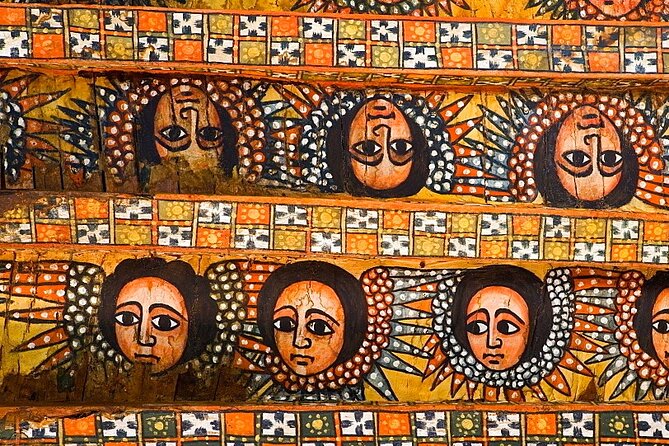
The name means Trinity and Mountain of Light. Twelve rounded stone towers surround the church, representing the 12 apostles. A taller 13th tower represents the Lion of Judah, and the lion’s imprint can be seen near the top.
The present building was redeveloped in the 1880s after the earlier church was destroyed by a raid from Sudanese Dervishes and then damaged by lightning. Its survival and rebuilding are part of the site’s story, but the paintings are what hold your attention once you are inside.
The church is famous for its painted decoration, including the well-known ceiling imagery. The supplied details note that the building was painted for worshippers who could not read, making the artwork an important way to communicate Christian teachings.
I like that this stop balances the military and royal focus of the earlier sites. Fasil Ghebbi tells you how emperors ruled. Debre Birhan Selassie shows how religious ideas were presented to ordinary worshippers through images.
You should treat the church as an active place of worship, not simply as an art museum. A guide can explain the figures and symbols, but you also need to allow space for the religious setting itself. Dress and behavior should be respectful, even though the supplied information does not list a formal dress code.
The two-hour duration may seem long if you only want a quick look at the ceiling. It makes more sense if you want time to examine the towers, church structure, paintings, and history of the rebuilding. If religious art is not your main interest, this may be the point in the day where you feel the schedule most strongly.
A few more options to weigh up in Gondar
- 6 Days tour Package (Simien Mountains, Lalibela, and Danakil Depression)
★ 5.0 · 32 reviews - 4 Days Trekking to Simien Mountain National Park
★ 5.0 · 7 reviews - Simien Mountains – 4 Days
★ 4.0 · 7 reviews - 2 Days Simien Mountains Trekking
★ 5.0 · 6 reviews
Wolleka and the story of Gondar’s Ethiopian Jewish community
The final listed stop is Wolleka, also called the former Falasha Village, with about two hours allotted. The name refers to the Ethiopian Jewish community that once lived there. Most members were airlifted to Israel in the 1980s, and none remain today according to the supplied information.
Craft stalls, Stars of David, and signs pointing to the Falasha Village identify the former community. A few original houses remain, with artwork on their fronts, along with a small synagogue. There is a small entrance charge of 10 birr to look inside the synagogue.
Wolleka adds a human dimension that the royal sites cannot provide. The story includes land confiscation after the adoption of Christianity as the state religion, since Falashas refused to convert. Many then survived by becoming skilled craftspeople, and research suggests they may have supplied labor for construction and decoration in Gondar.
I value this stop because it widens the tour beyond emperors and churches. It also asks you to think about which communities get remembered in a city’s official story and which are left at the edges.
There is a practical drawback. Persistent sales children may surround you, particularly near the synagogue and craft stalls. That can make the visit uncomfortable, especially if you prefer quiet, unpressured sightseeing. Go in knowing that commercial attention is part of the stop, and decide in advance what you want to buy, if anything.
Two hours is a long allocation for a small village area, so the actual pace may depend on your interest in crafts, the synagogue, and the guide’s explanation. I would ask for context before browsing the stalls. That helps keep the visit focused on the community’s story rather than turning it into a shopping stop.
The guide and vehicle make the schedule easier
An air-conditioned vehicle matters in a seven-and-a-half-hour outing. You move between several sites, and a cooled vehicle gives you a place to recover between visits. The tour also includes airport or departure tax, government taxes, entrance fees as listed, and a Blue Badge guide.
The strongest service detail available comes from a booking organized by Mickey. He arranged airport reception and connected the visitor with excellent local guides. That suggests the operator can coordinate more than a basic point-to-point ride, although the exact name of the guide for your date is not provided.
I would contact the operator before arrival to confirm three things: who will meet you, where the airport handoff happens, and whether the day ends at Central Hotel or another hotel requested during booking. The published end point is back at the meeting point, but the tour title also promises airport and hotel pickup.
The small group limit of 10 is another useful feature. You can usually expect better access to the guide than in a large bus group, and questions are less likely to get lost. The tour is also described as suitable for most people, but no detailed accessibility information is supplied, so ask directly if walking or mobility is a concern.
Is $90 a fair price for Gondar?
At $90 per person, this is not the cheapest way to see Gondar if you only want transportation. It becomes more attractive when you count the guide, vehicle, admissions, taxes, and the airport pickup option.
The tour covers four major cultural stops in one day. Fasil Ghebbi alone needs time, and the church and Wolleka are far more useful with explanation than with a quick photograph. If you would otherwise arrange separate transport, pay admission at several sites, and find a guide on arrival, the package can be reasonable.
The value also depends on group size. Up to 10 people is a modest maximum, but it is not a private experience. If you want complete control over how long you spend at each site, a private arrangement may suit you better, though no private upgrade is described here.
I would consider the tour particularly useful for a first visit, a short stay, or an arrival day when you want airport pickup and a structured introduction. If you are already familiar with Gondar and prefer long, quiet visits at one or two sites, the fixed schedule may feel restrictive.
Timing, cancellation, and who should book
The start time is 9:00 a.m., and the tour lasts approximately seven hours and 30 minutes. It is commonly booked about 18 days ahead, so I would reserve early if your Gondar dates are fixed.
Free cancellation is available up to 24 hours before the start time for a full refund. Changes or cancellations inside that 24-hour window are not accepted or refunded. The activity also requires a minimum number of participants, and if that minimum is not met, you are offered another date or experience, or a full refund.
I would book this tour if you want a practical first look at Gondar with the major royal, religious, and cultural sites combined. I would think twice if you dislike a busy sightseeing day, want a fully private itinerary, or feel uncomfortable with the sales pressure described at Wolleka.
FAQ
Where does the Gondar city tour start?
The published meeting point is Central Hotel in Gondar, at JF69+7RM.
What time does the tour begin?
The tour starts at 9:00 a.m.
How long does the experience last?
The tour lasts approximately seven hours and 30 minutes.
Does the tour offer airport pickup?
Yes. Pickup is offered, including airport pickup according to the tour details.
Where does the tour end?
The activity ends back at the meeting point, listed as Central Hotel.
What is included in the $90 price?
The price includes an air-conditioned vehicle, airport or departure tax, a Blue Badge guide, entrance fees as listed in the program, and government taxes.
How many people can join the tour?
The maximum group size is 10 people.
Is Fasil Ghebbi admission included?
Yes. Admission to Fasil Ghebbi is included in the program.
Can I cancel for a full refund?
Yes. You can cancel at least 24 hours before the experience start time for a full refund. Cancellations within 24 hours are not refunded.
Just added in Gondar
- Day trek to Simeien Mountains★ 5.0 · 3 reviews
- Simien Mountains National Park – 7 Day Trek★ 5.0 · 5 reviews
- Day trek to Simien Mountain★ 5.0 · 5 reviews
- 2 Nights 3 Days Trek to Semien Mountain★ 5.0 · 4 reviews
- 3 Days Simien Mountains Trekking★ 5.0 · 3 reviews
- Simien Mountains One Day Trip:Wildlife Spotting,Hiking Tour★ 5.0 · 2 reviews
- Gondar sightseeing tours:-full day★ 5.0 · 1 review
- From Gondar: 2-Day Simien Mountains Trekking Tour★ 5.0 · 1 review
City Tours, compared.
Addis Ababa Guided City Tour With Airport & Hotel Pick Up
Read our review →

Authentic Addis Ababa City Tour with a Local Guide
Read our review →
Addis Ababa City Tours Full Day With Hotel Pickup And Drop Off.
Read our review →Browse the lists this tour appears in