
Reviewed · SIMIEN MOUNTAINS TREKKING
3 Day Simien Mountains Tours
The cliffs arrive before the hard walking begins. This three-day trip gives you a fine introduction to Simien Mountains National Park, with huge escarpments, high plateaus, Jinbar Falls, and close encounters with gelada baboons. I like the mix of scenery and wildlife, and I like that the price includes park fees, guides, scouts, camping gear, transport, and meals. The main caution is altitude: much of the route sits above 3,200 meters, and the hiking is demanding even when the distances look modest.
I also like the small maximum group size, listed as no more than 10 or 15 people, depending on the booking details. That should make the walking more personal and keep logistics manageable. The drawback is that the pickup information is not fully consistent: the trip gives a 9 a.m. start at Cameroon Street in Addis Ababa, while the first-day plan describes pickup from a hotel or airport in Gondar. Confirm your exact starting point before paying.
In This Review
- Key points at a glance
- Why the Simien Mountains are worth three days
- Day 1: Debark, Sankaber, and your first cliff walk
- Day 2: Gelada baboons and the drop at Jinbar Falls
- Day 3: Imet Gogo, giant lobelia, and the return to Gondar
- What the $350 price really includes
- Fitness, altitude, and what to pack
- Transport and group size need a quick check
- Who will enjoy this trip most
- Should you book the 3-day Simien Mountains tour?
- FAQ
- Where does the tour start?
- How long is the tour?
- What is the highest point reached on this itinerary?
- Are park fees included?
- Is camping equipment provided?
- Are meals included?
- Can I cancel for a full refund?
Key points at a glance
- Three days at high altitude: Expect 5 to 8 hours of walking each day, with demanding climbs and thin air.
- Jinbar Falls and Imet Gogo: The second and third days bring the most dramatic viewpoints, including a waterfall dropping hundreds of meters and a 3,925-meter summit.
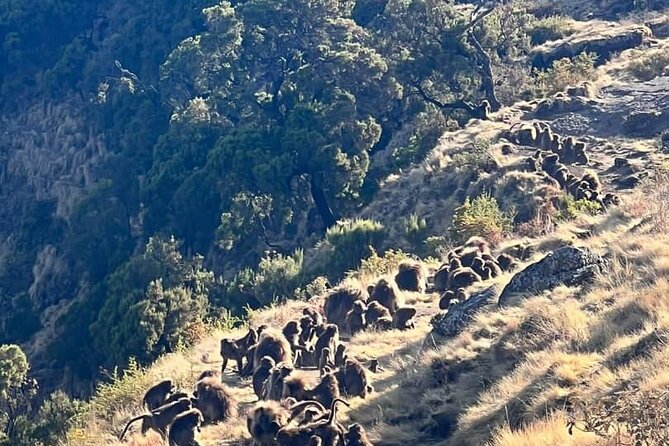
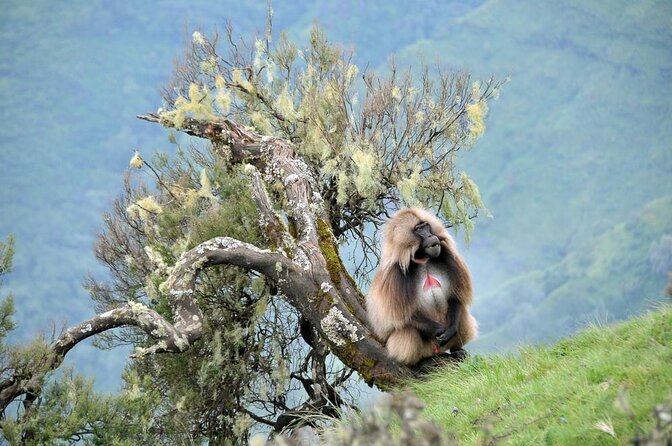
- Gelada baboons are a major highlight: Large groups forage across the highland grasslands, often close to the walking route.
- Camping and coffee ceremonies: Nights are spent at Sankaber and near Gich, with coffee and snacks after the day’s walk.
- Strong value at $350: Park admission, transport, camping equipment, a guide, scouts, mules, and nine meals are included.
- Plan for altitude, not just distance: A 12-kilometer day can feel far tougher above 3,000 meters than it would at sea level.
Why the Simien Mountains are worth three days
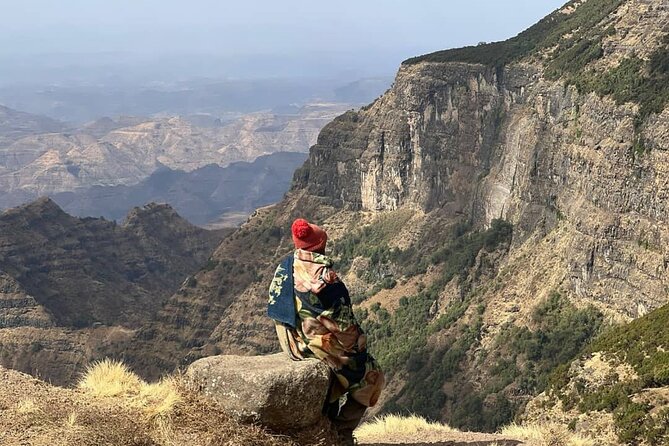
Simien is a place of sharp contrasts. You walk across open highland grasslands, then arrive at a cliff edge where the ground drops away into enormous valleys. Cultivated fields and villages appear beside wild escarpments. The views are not one single postcard scene. They keep changing as the trail follows the rim.
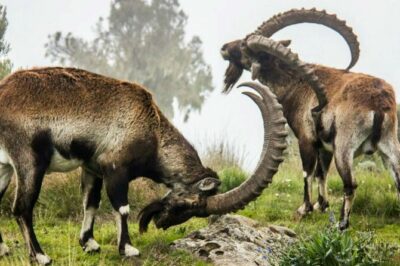
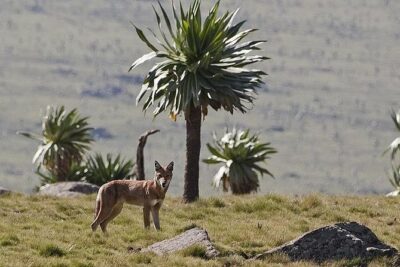
The park is protected as a UNESCO site, and its wildlife gives the walking extra purpose. More than 20 large mammal species and over 130 bird species are found here. You may see gelada baboons, the caracal, the lammergeier, the thick-billed raven, the Walia ibex, and, more rarely, the Ethiopian wolf.
The geladas are the most practical wildlife draw on this route. They forage in large groups and are a regular part of the highland experience. The Walia ibex and Ethiopian wolf are much less certain sightings, so you should treat them as possible rewards rather than promises.
The trip also gives you a taste of daily life in the mountains. At Gich, local people prepare coffee for walkers. In Ethiopia, the coffee ceremony is a social occasion, not simply a caffeine stop. After several hours on foot, a cup of fresh coffee can feel like a small ceremony of survival.
More Simien Mountains treks:
- 12 Days SIMIEN MOUNTAIN-LALIBELA-DANAKIL-TIGRAY CHURCHES
★ 5.0 · 45 reviews - Simien Mountains Trekking Adventure
★ 5.0 · 8 reviews - 3 Days Trekking Simien Mountains Tours
★ 5.0 · 6 reviews
Day 1: Debark, Sankaber, and your first cliff walk
The first day begins with transport toward Debark, the gateway town for the park. The drive from Gondar is described as taking about two hours, with a paved road continuing to Debark. At the park headquarters, you sign in, meet the local guide and scout, and continue into the mountains by 4×4 or minibus.
This part matters because the guide and scout are not optional extras in practice. The route runs through high ground with steep drops, changing weather, and remote camps. Their presence adds direction and local support, especially when the trail becomes less obvious.
Rather than driving all the way to Sankaber, you are dropped off for a three to four-hour acclimatization hike. That is a sensible first-day plan. You begin to adjust to the altitude while walking along a ridge, instead of arriving at camp with no preparation for the thin air.
The views start quickly. The route gives you an early look at the cliffs and valleys, but the walk is not a gentle stroll. Even a short climb can feel demanding at this elevation. You should keep your pace slow, drink regularly, and avoid treating the first day as a race.
A picnic lunch is included, which keeps the day simple. After lunch, the route climbs toward Sankaber, where the trip’s camping routine begins. The description promises fresh coffee, tea, and snacks when you reach camp. That small touch is useful after a high-altitude climb, particularly if you have spent the afternoon pacing yourself carefully.
You spend the night camping at Sankaber. Tents, mattresses, and sleeping bags are supplied, though bringing your own sleeping bag is recommended. That advice is worth taking seriously if you have a suitable one, since personal sleeping equipment can be more comfortable and familiar than shared or standard issue gear.
The first day lasts about seven hours when driving, walking, stops, and camp arrival are counted together. You should think of it as an acclimatization day with real exertion, not a soft opening.
Day 2: Gelada baboons and the drop at Jinbar Falls
The second day covers about 12 kilometers and takes roughly five to six hours on foot. It is the clearest example of why altitude matters more than the raw distance. Twelve kilometers would be manageable for many people at lower elevations, but here the trail moves through high grasslands, heather forests, cultivated fields, and sections beside the escarpment.
The route has variety underfoot and under view. You pass through areas shaped by both farming and wild vegetation, then return to the open edge of the mountains. That combination makes the walk feel like a journey through a lived-in region, rather than a simple point-to-point hike.
Gelada baboons are the day’s star attraction. You may encounter large groups foraging in the grasslands. Their presence makes this a good day for slowing down and watching rather than simply marching toward camp. Keep your camera ready, but remember that the park’s wildlife is part of the setting, not a scheduled performance.
The approach to Jinbar Falls includes clambering over a few rocks. This is not described as a technical climb, but it does mean you should wear sturdy shoes with a good grip. The viewpoint looks down toward a waterfall plunging several hundred meters into the abyss. The combination of moving water, vertical cliffs, and open space is one of the trip’s strongest visual moments.
After Jinbar Falls, the trail continues toward Gich. The village offers another important human element: local coffee prepared at the end of the day. The coffee ceremony can be one of the most memorable parts of the trip because it connects the trek to Ethiopian social life. It is also a practical pause after the hardest walking.
The second camp is close to Gich, and you spend another night in a tent. Dinner is included, as are breakfast and lunch on the scheduled days. The food plan is basic but useful: you do not need to arrange meals while moving between remote camps.
One thing to understand is that camping in this setting is part of the experience, not merely a cheaper hotel substitute. You should expect a straightforward mountain camp rather than comfort aimed at luxury. If you need a private room, reliable indoor plumbing, or a soft bed each night, this is not the right format.
Day 3: Imet Gogo, giant lobelia, and the return to Gondar
The third day is described as the most spectacular stage. You walk for about five to six hours, including a detour to Imet Gogo at 3,925 meters. This summit provides some of the strongest views of the entire route, with cliffs, gullies, and distant peaks spreading out in several directions.
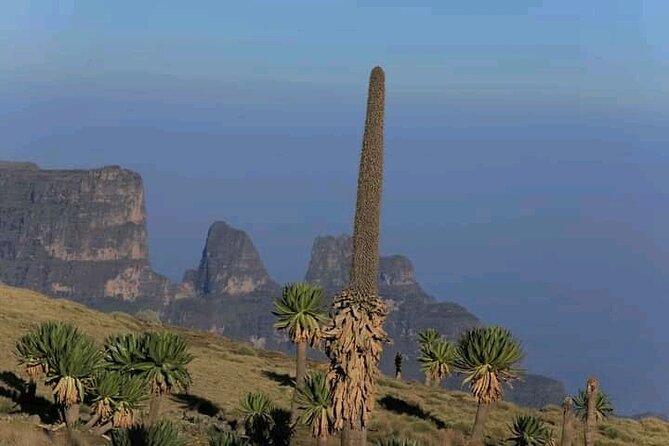
The trail also crosses the Gich Plateau, where giant lobelia grows in abundance. These plants give the high plateau a distinct look and help explain why the Simien highlands feel different from ordinary mountain country. You are not just walking through bare rock. The vegetation changes with the elevation and gives the route its own character.
Birdwatching is another focus on this day. The lammergeier, also called the bearded vulture, may soar overhead with a wingspan of around three meters. The endemic thick-billed raven is also expected in the area. The high cliffs make natural viewing points, so you should pause often and scan the open sky.
The planned route continues from Gich southeast across a deep gully toward Inatye. After lunch, you leave the walking route by vehicle near Ambaras and continue back toward Gondar. The day is listed at about eight hours, which reflects the trek, lunch, transfer, and road journey.
A useful clarification: the promotional description highlights Ras Dashen, Ethiopia’s highest point at 4,543 meters, but the three-day itinerary provided here does not include a climb to the summit. The route specifically names Sankaber, Gich, Jinbar Falls, Inatye, and Imet Gogo. If reaching Ras Dashen is your main goal, ask the operator if a different, longer itinerary is required.
A few more options to weigh up in Addis Ababa
- Full Day Tour of Addis Ababa with Hotel Pickup and Drop-off
★ 5.0 · 430 reviews - Taste of Ethiopia
★ 5.0 · 406 reviews - Day Trip From Addis Ababa See Historical Monastery,Stunning Nature,Animals,Birds
★ 5.0 · 303 reviews - Addis Ababa: Debre Libanos, Blue Nile Gorge, and Cave Tour
★ 4.5 · 256 reviews
What the $350 price really includes
At $350 per person, the tour offers good value if you want a guided, organized trek rather than arranging each part yourself. The price includes:
- Air-conditioned road transport
- Airport transfers and private minibus transport
- Park entrance fees
- Local guides and scouts
- Tents, mattresses, and sleeping bags
- Mules and a mule handler for camping and cooking equipment
- Breakfast for two mornings
- Dinner for two nights
- Lunch for three days
- Government taxes
The mule support is especially useful. It means the camping and cooking equipment does not all have to go on your back. You still need to carry your personal items, but the trip avoids turning the walk into a full-load expedition.
The inclusion of park admission and road transport also reduces the number of small costs that can catch you out. You are not paying separately for the guide, scout, camp equipment, or each transfer along the way. At this price, the main question is not simply if the tour is cheap. It is whether you want the convenience of a prepared route and support team.
Personal expenses are not included. You should budget for tips, souvenirs, and photo or video fees. The supplied information does not give fixed amounts for those extras, so ask for current guidance before departure.
Fitness, altitude, and what to pack
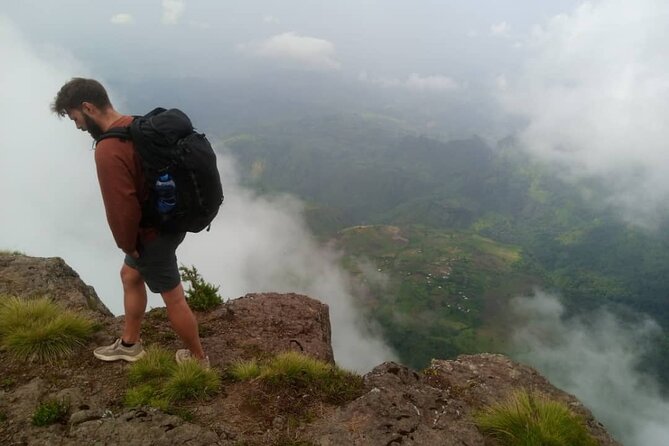
The tour asks for a moderate level of physical fitness, but I would treat that as a practical minimum rather than a guarantee of ease. Day one includes a three to four-hour acclimatization walk and a climb to Sankaber. Day two covers about 12 kilometers. Day three combines high viewpoints with a drive back to Gondar.
Altitude is the key issue. Much of the route is above 3,200 meters, and Imet Gogo reaches 3,925 meters. You may feel breathless on climbs that would seem ordinary at home. Walk slowly, take breaks before you are exhausted, and tell your guide if you feel unwell.
Useful items include:
- Sturdy walking shoes with good grip
- Warm layers for high camps
- Sun protection
- Water and a daypack
- Personal medication
- A sleeping bag, if you have one you prefer
- Camera equipment, with the understanding that photo and video fees are excluded
Weather conditions can change quickly in mountain areas, so layers are more useful than one heavy garment. The information confirms camping equipment is supplied, but it does not describe the exact quality or warmth rating. If you are sensitive to cold, bring your own sleeping bag and warm clothing.
Transport and group size need a quick check
The trip offers pickup and a mobile ticket, but the meeting details need clarification. One set of instructions gives Cameroon Street in Addis Ababa as the start and end point at 9 a.m. The day-one schedule describes pickup from a hotel or airport in Gondar at about 9 a.m., followed by the two-hour drive to Debark.
Those locations are not interchangeable. Addis Ababa and Gondar are far apart, and the tour description does not explain how a participant moves between them. Contact Danakil Depression Tours before booking and confirm:
- Your exact pickup city
- The airport or hotel pickup arrangement
- Where the trip ends
- Whether flights or transport to Gondar are included
- The final group size
The maximum is shown as either 10 or 15 people. A group of 10 would feel quite manageable on mountain trails, while 15 could be less quiet and slower at viewpoints. The actual group size may also affect how personal the guiding feels.
Who will enjoy this trip most
You should consider this tour if you want strong mountain scenery, wildlife, camping, and a planned support team in a short format. It suits you best if you can handle several hours of walking at altitude and are comfortable with basic camp conditions.
It is a particularly good fit for:
- Hikers with moderate fitness
- Wildlife lovers hoping to see gelada baboons and highland birds
- Photographers seeking cliffs, waterfalls, and wide viewpoints
- First-time visitors who want transport and park arrangements handled
- People who enjoy local experiences such as the Gich coffee ceremony
It may not suit you if you want a relaxed sightseeing trip with little walking. It is also not ideal if your main purpose is to summit Ras Dashen, since this schedule names Imet Gogo as the high point of the walking route rather than a Ras Dashen ascent.
The overall customer rating is listed as 5 from three reviews. The most praised points are the stunning views, well-coordinated arrangements, good English from the guide in one account, and attentive service. One person ended up alone after two other participants canceled, which shows that group size can change. That could be a benefit if you prefer quiet walking, but it may feel less social if you expected a larger group.
Should you book the 3-day Simien Mountains tour?
I would book it for the scenery, wildlife, and value, provided the pickup details are settled first. The route gives you three useful days in the park without asking you to carry all the camp equipment, and it includes the major sights at Jinbar Falls and Imet Gogo.
The best reason to choose it is variety. You get ridge walking, cliff viewpoints, gelada baboons, giant lobelia, large birds of prey, village coffee, and two nights under canvas. The biggest warning is altitude, followed closely by the unclear Addis Ababa and Gondar meeting information.
Book this trip if you want a compact mountain adventure and can accept basic camping. Ask about the starting city, actual group size, sleeping bag condition, and whether a Ras Dashen climb is possible before you confirm. With those points clear, $350 is a fair price for a supported three-day trek in one of Ethiopia’s most dramatic national parks.
FAQ
Where does the tour start?
The meeting information gives Cameroon Street in Addis Ababa as the start point at 9 a.m. The first-day schedule instead describes pickup from a hotel or airport in Gondar at about 9 a.m. You should confirm the exact pickup city with Danakil Depression Tours before booking.
How long is the tour?
The experience lasts approximately three days. The walking days are listed at about seven hours on day one, six hours on day two, and eight hours on day three, including transport and other parts of the schedule.
What is the highest point reached on this itinerary?
The itinerary includes a detour to Imet Gogo at 3,925 meters. Ras Dashen, at 4,543 meters, is highlighted in the general description, but the scheduled three-day route does not list a climb to its summit.
Are park fees included?
Yes. Simien Mountains National Park entrance fees are included in the tour price.
Is camping equipment provided?
Yes. Tents, mattresses, and sleeping bags are provided. Bringing your own sleeping bag is recommended.
Are meals included?
Yes. The price includes two breakfasts, two dinners, and three lunches.
Can I cancel for a full refund?
Yes, if you cancel at least 24 hours before the experience start time. Cancellations made less than 24 hours in advance are not refunded, and changes within that period are not accepted.
Just added in Addis Ababa
- Yod Abyssinia Cultural Night: Dinner, Music, and Dance★ 5.0 · 7 reviews
- Addis Ababa City Tours Full-Day Tours★ 5.0 · 5 reviews
- Locally crafted beer and wine tasting and nightlife in Addis tour★ 5.0 · 6 reviews
- Unique Ethiopian Cooking Class and Coffee Ceremony with a Local in Addis Ababa★ 4.5 · 7 reviews
- Stunning Views Wonchi Crater Lake a Private Day Trip★ 5.0 · 3 reviews
- Visiting the wonders of Lalibela in Three (3) days and Two ( 2) nights★ 5.0 · 2 reviews
- .2- Days and 1 Night Tour To Awash National Park water falls★ 5.0 · 1 review
- Two days Lake Wenchi and Menagesha Forest★ 5.0 · 1 review
Simien Mountains Trekking, compared.
12 Days SIMIEN MOUNTAIN-LALIBELA-DANAKIL-TIGRAY CHURCHES
Read our review →
6 Days tour Package (Simien Mountains, Lalibela, and Danakil Depression)
Read our review →
5-Day Northern Ethiopia Tour : 3D Simien Mountains Trek & Axum.
Read our review →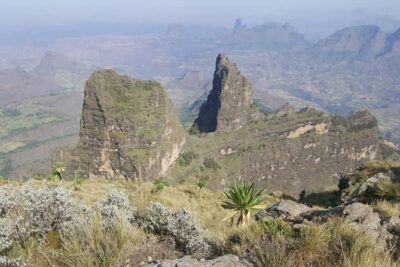
4 Days Trekking to Simien Mountain National Park
Read our review →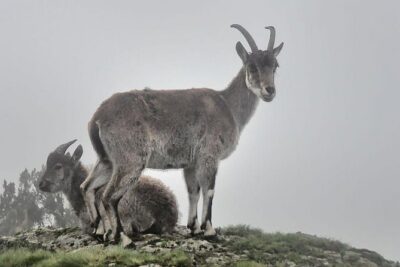
Browse the lists this tour appears in